
Context
Aquasys manages "The Water Observatory," a platform centralizing critical environmental data for local territories. The redesign had to serve two radically different profiles, field technicians needing granular data and elected officials needing high-level surveillance indicators for emergency situations, while working within the existing technical architecture.
The Goal
Convert an expert-oriented platform into a strategic tool for local governance, designing an intuitive layer within the existing architectural boundaries.
Year
2024
N°1 Outcome
NPS jumped +58 points, rising from -18 to +40.
A Technical Tool in Need of Clarity
Aquasys manages "The Water Observatory," a platform centralizing critical environmental data for local territories. Despite its technical depth, the tool was failing to support decision makers effectively because of a lack of clarity in its user interface. For elected officials, the legacy interface felt fragmented and overly technical, making vital information regarding flood risks or drought levels difficult to extract during emergency situations.
Bridging the Expertise Gap
Our objective was to convert this expert-oriented platform into a strategic tool for local governance. A major constraint defined the project: we had to modernize the entire user experience while preserving the tool's fundamental technical structure. We were tasked with designing an intuitive layer within the existing architectural boundaries.
Methods Used
Screens
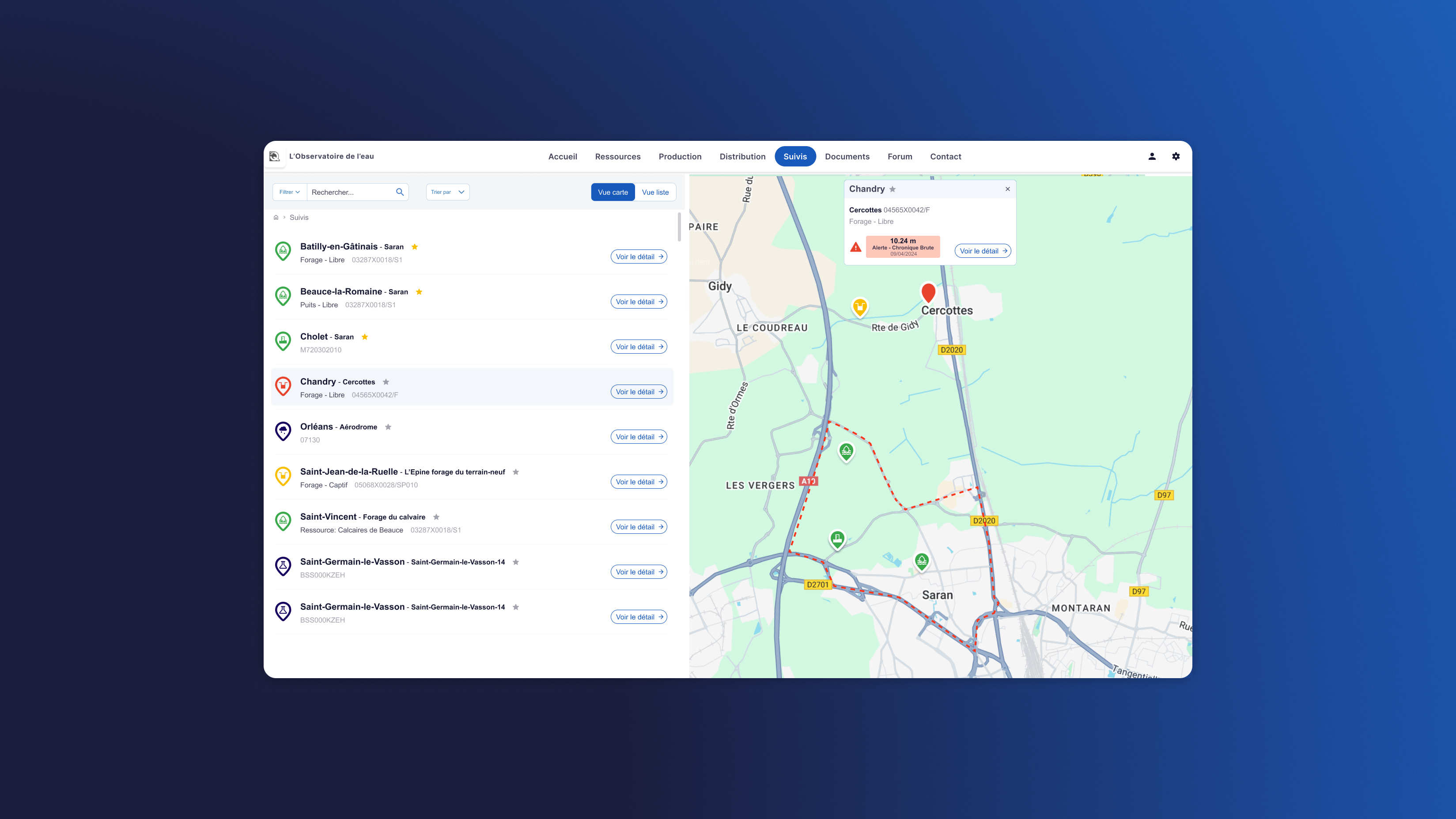
Tracking page prototype
Split-screen monitoring view: the map provides spatial awareness while the left panel lists actionable points of interest, with details and a 'See more details' option.
Strategy & Execution
User Research
Designing for the Urgent and the Expert
We conducted interviews to map two radically different user profiles. We identified technicians needing granular data and elected officials needing high-level surveillance indicators for rapid response.
UI Strategy and Features
Personalization & Information Hierarchy
We implemented personalization and improved the information hierarchy. This included a customizable dashboard to match the user's needs and level of expertise.
Navigation and Split View
Full Control Over Data Display
We reinforced the information hierarchy and introduced advanced filtering options directly on the map. To support diverse workflows, we designed a flexible dual-view interface, combining a dynamic point-of-interest list with a collapsible map, giving users complete control over their data display.
Stakeholder Alignment
Milestone Meetings Framework
To ensure our design decisions remained aligned with the client's operational requirements, we established a framework of milestone meetings to maintain consistent communication throughout the project.
Outcomes
NPS Score
A Massive Satisfaction Boost
The Net Promoter Score jumped by 58 points, rising from -18 to +40.
User Feedback
"I am not a magician, but if I had a magic wand, I would want this solution to be online right now."
User Testing Session Participant
Implementation
Scrum Agile Rollout
Aquasys has validated our recommendations and is implementing them gradually using the Scrum Agile method.
"The project's central constraint, designing within Aquasys's existing technical architecture, was also its main creative obstacle. It meant building an intuitive layer without the freedom to rethink the platform's foundations, which shaped and sometimes limited design decisions. Simultaneously serving two radically different profiles required constant trade-offs: an interface clear enough for elected officials must not feel reductive to expert technicians."