
Sum Up
Context
The French publishing market faces a paradox: while 2.5 million people write, only 0.01% of their manuscripts are published. Authors endure an opaque process, while publishers are overwhelmed by submissions managed through artisanal tools like local spreadsheets.
The Goal
Create a mediation tool that fluidifies the process without sacrificing the human "editorial eye" that defines the industry.
Year
2025
N°1 Outcome
Delivered a dual-sided platform validated through iterative testing with authors and editors.
From Insights to Action: Architecting Trust
Transitioning from discovery to execution, I translated the frustrations of our 60 survey respondents into a functional ecosystem . My primary action was to spearhead the design of dual-sided interfaces: a transparent tracking dashboard for authors, and a high-efficiency triage tool for publishers to regain control over their workflow.
Methods Used
Low-fi iterations
Relieving editors of time-consuming tasks = Improving authors well-being
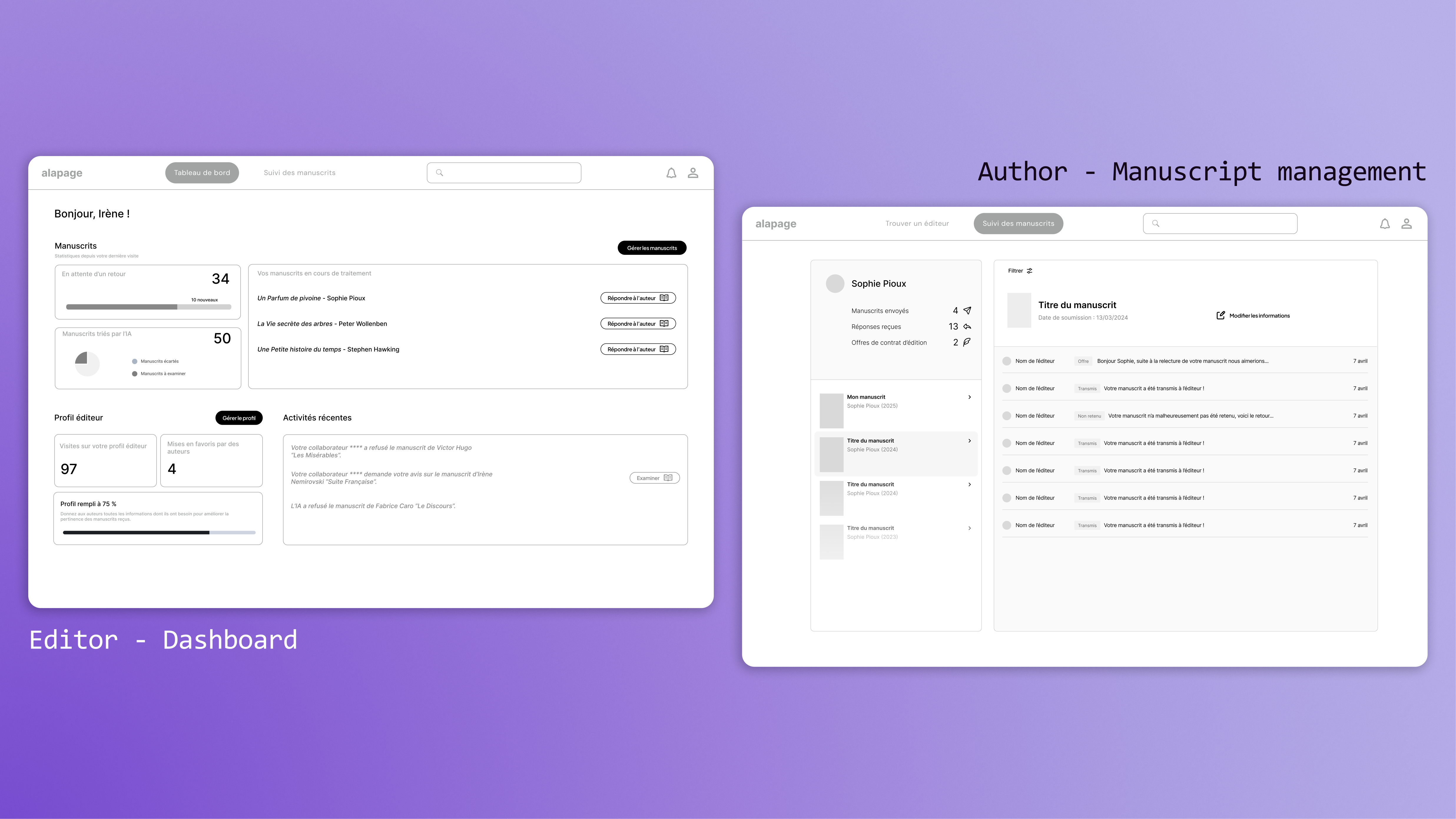
Editors lack time and people to treat all manuscript equally. Alapage give them a centralized solution, powered by an AI-scoring system (think ATS like). In the same time, authors can now follow the submited manuscript status in every publishing house: sent, in revision, rejected, accepted.
Transparency, Assistance, Sovereignty
Author Interface
A transparent tracking dashboard for authors to break the "black box" effect, manuscript status visible at every stage, across every publishing house .
Assisted Decision-Making
A custom smart triage logic where AI assigns a scoring system (1–100) based on criteria defined by the editors themselves. Technology remains an assistant, not a gatekeeper: the human "editorial eye" stays at the center of the process.
Sovereignty by Design
To overcome the industry's resistance to AI, we made the strategic choice to integrate Mistral AI. This provided the sovereign infrastructure required to guarantee creative intellectual property protection, a non-negotiable for our users.
High-fi iterations
Validating the core experience with real users
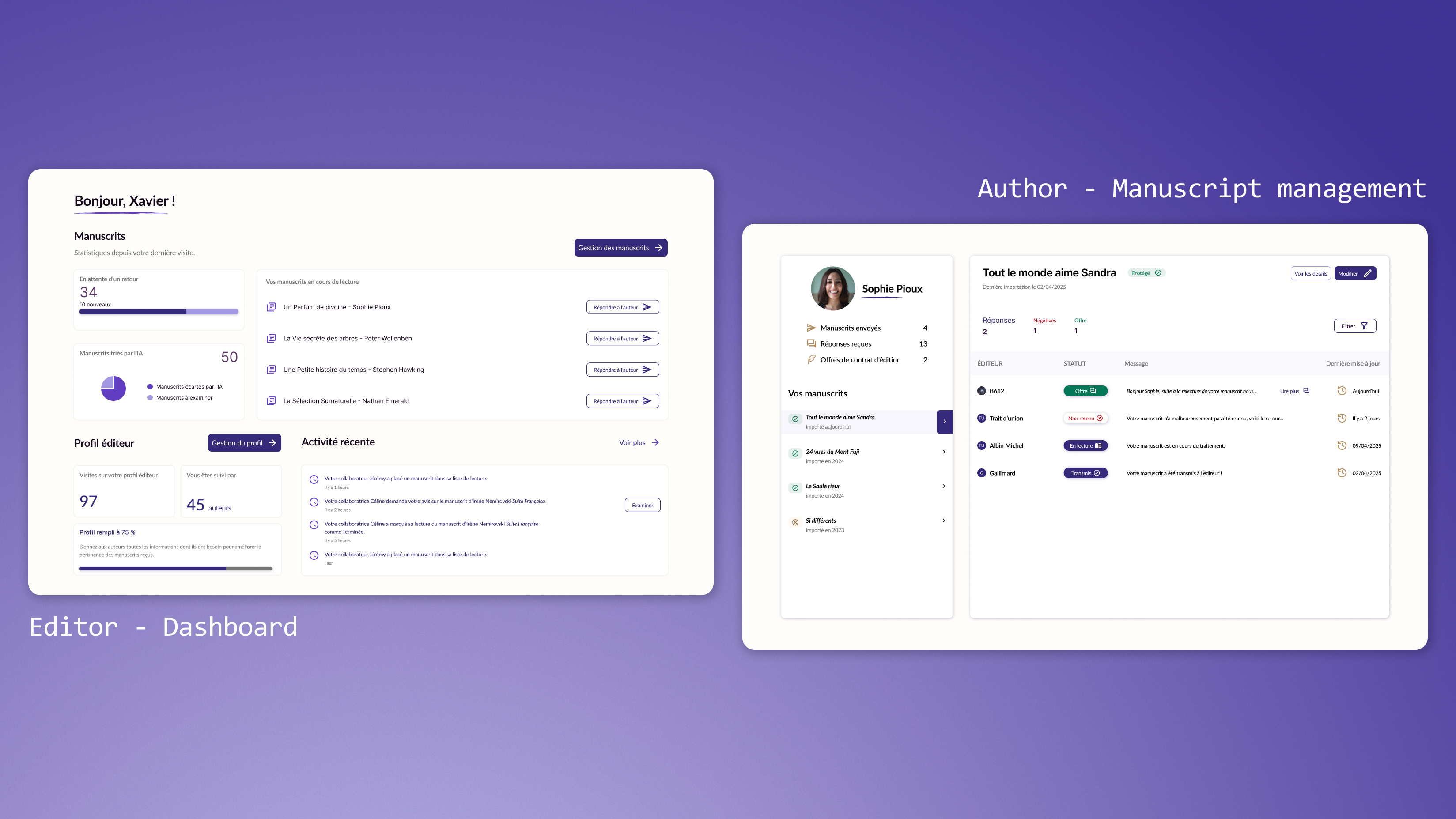
After user testing, on the authors side, we add the protection status of their manuscripts and change the management table multiple lines by editors to a single line, updating at any status change. On the editors side, the dashboard was mainly kept as it is, as its efficiency was validated by the users.
Outcomes
Validated Experience
Delivered a high-fidelity prototype validated through iterative testing with real authors and editors. This allowed us to pivot our navigation logic based on direct feedback, ensuring a trust-building interface.
Immediate Profitability
Engineered a sustainable SaaS model. The structure balances affordable author access (17€/month) with scalable tiers for publishing houses.
Full-Cycle Vision
Defined a 3-year technical roadmap to transform Alapage into the reference collaborative workspace for the entire editorial cycle.
"Despite the technical success, testing revealed deep-seated editorial resistance to automation. I realized that in tech-averse sectors, design must be focused on pedagogy. We pivoted our strategy to include a White Book to build cultural credibility before selling the tool."